June 2026: The new intake, Part 2
Welcome to Part 2 of our in-depth look at the new trees delivered in the 2025/26 planting season. In Part 1 we covered taxonomy (the science of classifying trees) and listed our new saplings by numbers: how many new plantings there were for each street in Herne Hill, how many of each species were planted, and which species were climate-safe.
Below we're listing each tree by its scientific niche: the wide family it belongs to, its narrower genus, or group of related trees, its individual species name and the name of its variety or cultivar, if there is one. If you see an 'x' in the name it indicates that the tree is a hybrid. And of course there are photos for each entry. If you want to refer to a full spreadsheet giving the location of each new tree you’ll find it here.
The gymnosperms (non-flowering trees, mostly conifers) come first, followed by the angiosperms (flowering trees, mostly broadleaves). We covered the conifers and other evergreens in our April 2026 blog so those particular notes are going to be short. The New label indicates a species that we haven't previously seen on Herne Hill's streets.
THE GYMNOSPERMS
The plum yew family (Cephalotaxaceae)
New! Genus: Cephalotaxus. Species: Cephalotaxus harringtonia (Japanese plum yew)
The first and smallest of the 2026 crop, one of two new occupants of a previously bare grass verge on Sunray Avenue. At present it's a small shrub and it'll never reach more than five metres (16 ft) in height. It clearly wasn't planted for its towering presence, but it will tolerate the dense shade cast by the big London planes on either side. Its fruit is the shape, size and colour of a ripe acorn and takes two years to mature.

The cypress family (Cupressaceae): cypresses and junipers
New Genus: Cupressus. Species: Cupressus sempervirens 'Pyramidalis' (Italian cypress)
In its Mediterranean and Adriatic homelands this very narrow, columnar tree, a staple of Italian and Greek landscapes, can reach up to 45 metres (150 ft) in height and will keep its slim waistline into old age. In Britain it can get to 12 metres or more in a garden, but expect less on Elmwood Road. Its prolific, knobbly cones are worth a close look. The Field Guide to the Trees of Britain and Northern Europe describes them as 'Shining green as first, then persisting dark red-brown, finally dull grey when old,' which goes for many of us. As a closing insult it calls the cones 'lumpy ovoid' (egg-shaped).

The pine family (Pinaceae): silver firs, cedars, larches, spruces, hemlocks and pines
New Genus: Cedrus. Species: Cedrus libani (Cedar of Lebanon)
This is the seventh cedar of Lebanon in the lawns around the Denesmead flats, on Herne Hill next to St Paul's church. Denesmead and the neighbouring Pynnersmead are among the few places in Herne Hill with enough space for really sizeable trees. You'll have seen these cedars in big London parks and the grounds of stately homes, where they can can spread their enormous, horizontally layered branches. The huge cones are spectacular, nestling in the dense, dark needles. All the pine family have needle-like leaves (pictured below left) and woody cones with spiralling scales.
New Genus: Pinus. Species: Pinus nigra Austriaca (Austrian pine)
Trees in the genus Pinus are unique in having leaves made up of needles in bunches of two, three or five. The Austrian (pictured below right) is a two-needle pine with a wide crown that will grow very rapidly. In the wild they can reach 50 metres (160 ft). Ours, planted on the same grass verge on Sunray Avenue as the plum yew, is tiny now but will also get bigger fast, although not that tall. The picture shows the Austrian pine's new shoots, known as 'growth candles'. Bonsai gardeners pinch them off to encourage lower branching. Small, yellow flowers are followed by dark green, pointed cones, maturing to light brown. We have four other black pines (Pinus nigra) of an unknown variety on Red Post Hill, in the crescent-shaped lawn outside nos. 65 and 79, and they're nowhere near 50 metres. They're rather dull to look at, and the multi-stemmed birches planted between them haven't done as well as we'd hoped.

THE ANGIOSPERMS
The walnut family (Juglandaceae): wingnuts, walnuts and hickories
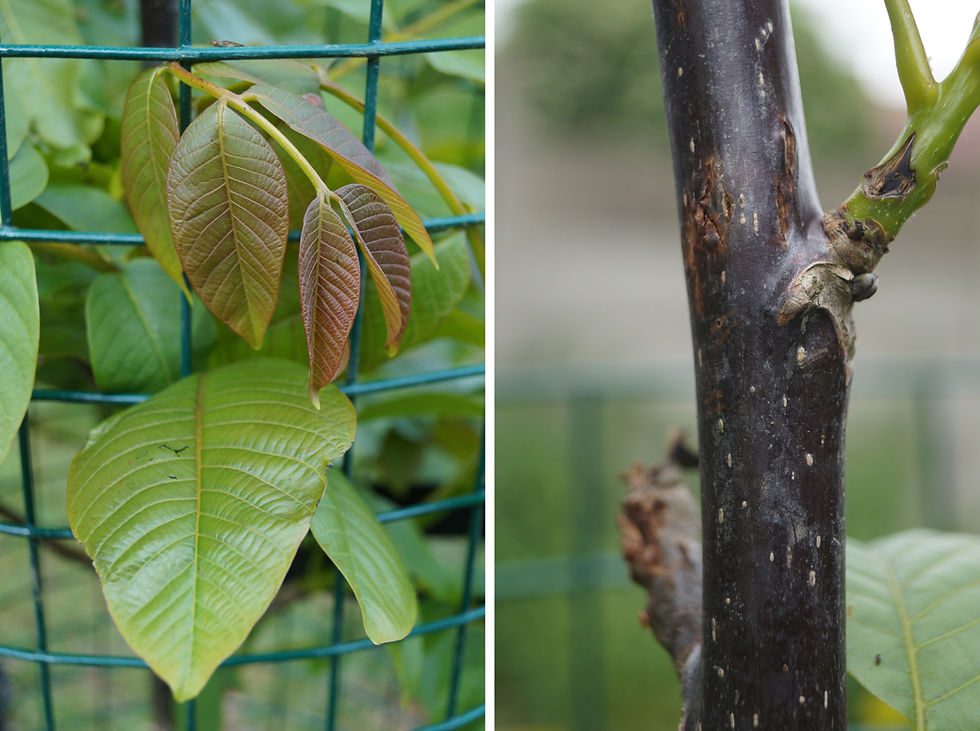
New Genus: Juglans. Species: Juglans nigra (Black walnut)
This new arrival means we now have two walnut trees in Herne Hill's housing estates, although this one is pretty hard to find. It's hidden away at the back of Hillcrest, near the top of Sunray Avenue. Walk along the tarmac path outside flats 31-45, turn right where the path ends, keep going along the concrete wall to your left and the walnut is the next tree down from the big London plane. Our other walnut is much easier to visit. It's just behind the white picket fence at the front of the Delawyk estate, facing 123 Half Moon Lane. It's a common walnut (Juglans regia), native to the Balkans and a different species to the black walnut, which is a North American tree. You can tell them apart by the leaves (black walnut: pointed, common walnut: rounded) and the bark (black walnut: dark brown, common walnut: pale grey). The nuts of both trees are edible.
The birch family (Betulaceae): birches, alders and hornbeams
New Genus: Betula. Species: Betula nigra (River birch or Black birch)
Like other birches, the most striking feature of the river birch is its bark. It starts as a pale, creamy brown, then as the tree matures it darkens and breaks up into tatters and strips that hang down from the branches. It originates from the eastern United States, where its natural habitat is swampland and river banks. In Britain, though, it prefers drier, sunnier conditions. It produces male and smaller female catkins in spring and yellow foliage in autumn.
Genus: Carpinus. Species: Carpinus betulus 'Lucas' ('Lucas' hornbeam)
This is a narrow and compact cultivar of the native common hornbeam, a beautiful and shapely tree with a very regular, fan-like profile: lower branches almost horizontal, then gradually closing the angle to the stem as they ascend, creating a perfect dome. We've got big, wide hornbeams on Sunray Avenue, in the square outside the Casino Avenue flats and on Burbage Road where it meets Stradella Road, but the 'Lucas', on Beckwith Road, is grown for more restricted spaces. There's a similar fastigiate (upright) hornbeam at the top of Danecroft Road. Look out for the pretty hop-like fruit in summer and leaves that cling on throughout the winter.

The elm family (Ulmaceae): elms, zelkovas and nettle trees
New Genus: Ulmus, Species: Ulmus glabra 'Camperdownii' (Camperdown elm)
This is a weeping variant of the wych elm, Britain's only true native elm, devastated in the outbreak of Dutch elm disease that began in the 1970s and is still active. It seems an odd choice for a pavement site, being wider than it is tall and drooping almost to the ground. Here's a photo from Wikipedia of an older and completely impenetrable Camperdown in Brooklyn. Southwark has planted several disease-resistant elms in recent years but this isn't one of those. It originated as a small, twisted wych elm discovered in Dundee about 190 years ago and it's been propagated since by grafting the mop-like head on to a stem of the parent tree. It's possible that its stunted height could protect it from disease since the elm bark beetle that carries the fungus won't usually fly low. This new one outside 40 Red Post Hill brings the number of local elms to six. The others are:
a Rebona elm at the Pynnersmead flats on Herne Hill
a Princeton elm, also at Pynnersmead
a smooth-leaved elm outside the Baptist church, Half Moon Lane
another Rebona on the front lawn of the Elmwood flats, Half Moon Lane
and a Sapporo elm on Elmwood Road, at the spot where the low wall from Half Moon Lane ends and the original high wall with its brick columns begins.

Genus: Celtis. Species: Celtis australis (Southern nettle tree)
Here's a relative of the elms, also from the Ulmaceae family: a charming little Southern nettle tree on Hollingbourne Road. We've got another specimen at 60 Burbage Road and a third on Stradella Road, at the side of 23 Burbage. The Stradella tree had another Celtis at its side until Storm Eunice blew it down in February 2022. It's a hardy, drought-tolerant tree, native to southern Europe and Turkey, and produces small, edible fruits called drupes - stone fruits, like plums and cherries. They change from green to yellow, orange, red and finally purple-black.

The magnolia family (Magnoliaceae): magnolias and tulip trees
Genus: Magnolia. Species: Magnolia kobus (Northern Japanese magnolia)
We've written a lot about kobus, one of our favourite magnolias, most recently in September 2025. It's the one with the odd-looking bright red fruit and has spread from its stronghold on Casino Avenue to Burbage Road, Hollingbourne Road, Frankfurt Road and now Stradella Road. Coincidentally the new tree occupies the spot where the fallen nettle tree lived until 2022. It was followed by a hornbeam, but that died too. So keep your fingers crossed!

The plane family (Platanaceae)
Genus: Platanus. Species: Platanus x hispanica (London plane)
This new London plane, in the grass verge outside the Cassinghurst flats on Red Post Hill, needs no introduction. It's one of 160 or so planes in Herne Hill. It's gratifying to see a young one planted, since a number of the big planes that have been felled recently have been replaced by something much smaller. There's a photo of its distinctive leaves above, next to the magnolia. They resemble the foliage of the sugar maple (Acer saccharum), which gave the London plane its alternative botanical name: Platanus x acerifolia, meaning maple-leaved plane.
The rose family (Rosaceae): quinces, apples, pears, rowans, whitebeams, service trees, snowy mespils, medlars, hawthorns, cherries and plums
New Genus: Malus. Species: Malus 'Evereste' ('Evereste' crab apple)
The massive rose family (Rosaceae) makes up 45% of this year's new trees (22 out of 49), including many popular ornamental street trees. We'll start our survey with the apples (Malus). The 'Evereste' is a new crab for Herne Hill, late-flowering and bearing persistent red fruit. Barcham's, one of the council's main suppliers, call it their favourite white-flowering apple and have a great photo of the blossom on their website. Our own 'Evereste' is planted in grass in the lower cul-de-sac on Casino Avenue, replacing a young Indian bean tree that fell in high winds two years ago.

New Genus: Sorbus. Species: Sorbus ulleungensis 'Olympic Flame' (Ulleung Island rowan)
This interesting little tree with its exotic name comes from Ulleung, a volcanic island 75 miles off the South Korean mainland with a population of just 10,000. Sorbus ulleungensis was only identified in 1976 and formally classified as a new species in 2014. Like all the rowans, its leaves are 'pinnate' (compound leaves made up of opposite rows of small 'leaflets'). The Royal Horticultural Society (RHS) describes its 'startling autumn colour as the large leaves with their many leaflets turn vibrant reds and oranges'. It's planted at 33-35 Half Moon Lane, just a few yards from the site of a large London plane that was felled late last year. If you walk by you can see the green berries, which will later turn red and persist until winter.

Genus: Sorbus. Species: Sorbus torminalis (Wild service tree)
Another interesting Sorbus, and another British native. This year's planting list included two wild service trees, both on Burbage Road, to complement the one that was planted in the top cul-de-sac on Casino Avenue in 2025. It's a rare tree in the wild and an important signifier of ancient woodland at least 400 years old. The leaves are unlike any other Sorbus and turn golden brown in autumn. The fruits, shown in a photo from the Woodland Trust, are known as chequers and were once used as a flavouring for beer. Forest Research, the research agency of the Forestry Commission, says the name 'service tree' derives from the Latin word for beer, cervisia. Paul Wood, an author who blogs as 'The Street Tree', has a recipe for chequer schnapps.
Genus: Sorbus. Species: Sorbus x thuringiaca (bastard service tree)
The unfairly named bastard service tree is visually and genetically a cross between a whitebeam (Sorbus aria), with its single leaves, and a rowan or mountain ash (Sorbus aucuparia), whose leaves are pinnate. If you look closely at the leaf in the right-hand photo, taken on Warmington Road, you'll see the scalloped margins turn into separate opposite leaflets near the stalk. All Sorbus readily hybridise in nature, and there are multiple hybrid whitebeams unique to the Avon Gorge in Somerset. Maybe this spontaneous coupling by its parents gave the unfortunate offspring the name 'bastard'. As well as the new tree on Warmington there are two others on Danecroft Road.

Genus: Sorbus. Species: Sorbus aria 'Magnifica' (whitebeam)
This is a narrow, upright cultivar of the native whitebeam, although it will spread as it ages. Whitebeams are attractive medium-sized trees with easily recognised leaves. The upper surfaces are glossy green but the undersides are downy and almost white. The big heads of creamy flowers turn into bunches of red fruit in late summer, but as the Field Guide rather dismissively says of the berries: 'Seldom numerous or conspicuous for long; soon eaten by birds.' The left-hand picture is the new tree at 62 Burbage Road in flower; the right-hand one shows the pale undersides of whitebeam leaves at no. 150.

New Genus: Amelanchier. Species: Amelanchier lamarckii (snowy mespil)
This is another first for Herne Hill - or maybe a double first, since there are two new snowy mespils on Frankfurt Road. It's difficult to find any information on the streetworthiness of this species in tree guides, since it's primarily a garden tree, but we can say with confidence that it's a fine multi-season choice. There are beautiful white flowers in the early spring, red to purple berries in the summer (unless the wood pigeons get to them before you) and excellent leaf colour in the autumn. It's moderately drought-tolerant, so the watering bags still need topping up for the first three years. We'll be watching this pair closely to see how they cope with the city environment.

New Genus: Crataegus. Species: Crataegus monogyna and Crataegus monogyna 'Stricta' (common hawthorn)
Next in the very large rose family (Rosaceae) come the hawthorns. Six new ones arrived in first quarter 2026. These are all tough little trees, giving us sweet-smelling blossom in May (hence their traditional name of May trees) or nowadays in April, thanks to the heating climate shifting the seasons. Most of them bear thorns, some thick and long and curved like scimitars, most of them smaller and not so vicious. All of them have long-lasting berries known as 'haws', mostly red but occasionally orange. But apart from a few well-behaved species and varieties they can look a bit of a tangled mess in winter, when the branches are bare. This is certainly the case with the countryside common hawthorn (Crataegus monogyna), one of our two native thorn trees. We have three new common thorns this year: one on Elmwood Road, one on Red Post Hill, tucked away behind the Carterscroft flats, and on Ruskin Walk another called Crataegus monogyna 'Stricta', a very narrow cultivar with ascending branches - the first of its kind here. Our other native is the Midland hawthorn (Crataegus laevigata), which will be familiar to you as the 'Paul's Scarlet' cultivar - the one with masses of gorgeous dark pink flowers.

Genus: Crataegus. Species: Crataegus x prunifolia (Broad-leaved cockspur thorn)
This year we welcomed two new saplings of possibly the shapeliest hawthorn there is, the broad-leaved cockspur thorn (Crataegus x prunifolia). The 'cockspur' in the name alludes to the lethal spike worn on the legs of fighting cocks, like this one from the Horniman Museum. This is one of our all-time favourites for its neat habit of tiered branches, its dark, glossy leaves, its bee-friendly flowers, its gleaming red berries, its yellow and brown autumn colours and, yes, its spectacular cockspur-shaped thorns, which seem to be guarding the flowers in the left-hand picture below. There were only one or two prunifolias in Herne Hill when Tree Watch started up in 2019. Now they're on Casino Avenue, Ruskin Walk, Warmington Road, Hollingbourne Road, Half Moon Lane, Red Post Hill, Carver Road and Danecroft Road, the latest pair. The Warmington tree has among the best thorns.
Genus: Crataegus. Species: Crataegus x lavallei (Hybrid cockspur thorn)
There was one final hawthorn in the 2025/26 batch, and it's another fine tree that we've long been waiting for: a hybrid cockspur thorn, planted on Half Moon Lane next to the bench at the 37 bus stop to Putney Heath. There's only one other lavallei in Herne Hill, an excellent example on Hollingbourne Road, outside no. 19, which always puts on a glorious display of orange-red fruit that lasts through the winter. The dark green leaves also persist until year's end, but without any real autumn colour. The pretty flowers are shown below right. Again, the habit is very attractive: branches not tiered like the prunifolia but upswept and sinuous, with the dense network of twigs creating a witches' broom effect. We lost one lavallei from Stradella Road in January 2024 when it fell victim to Storm Isha. This wintertime photo from two years ago shows the Stradella tree on the left, the more graceful of the pair, and the Hollingbourne tree on the right.

Genus: Prunus. Species: Prunus cerasifera 'Nigra' (Black cherry plum)
The last of the Rosaceae for this blog are the cherries (Prunus). Last winter/early spring brought us eight cherries of four different species. Three of the species are already familiar to us, and one came as part of a big evergreen delivery. The cherry plums are a popular tree, mainly because they're the first to flower every year, around mid-February, and make a joyful sight at an otherwise bleak, dark time of year. They all have wine-coloured leaves but the 'Nigra' cultivar comes out in pink flower and 'Pissardii' in white. We've had a lot of losses among the cherry plums in the past few years, either to old age, fungal disease or storm winds, but there's been a good deal of restocking going on too. Elfindale Road, to take one location, lost two of its three cherry plums in 2022 but is now up to four. The most recent planting was at no. 70-72, where the pink plum stands right in front of the postbox, next to its twin at 68. Both are shown below left.
Genus: Prunus. Species: Prunus x yedoensis (Yoshino cherry)
The next cherry is also an early bloomer and needs no introduction at all. It's the famous yoshino cherry, which has become Herne Hill's signature tree in recent years, bringing blossom tourists to Winterbrook Road when the white (later pale pink) flowers emerge in mid-March. It's a wonderful, vigorous tree, with terrific autumn colours too, so it's no wonder residents ask for it. Two were planted this spring on Ruskin Walk, opposite each other at nos. 56 (see photo below right) and 57. So now, starting from their original base on Winterbrook, we also have yoshinos on Casino Avenue, Danecroft Road, Hollingbourne Road, Ruskin Walk, Stradella Road, Warmington Road and Wyneham Road: eight streets altogether.

Genus: Prunus. Species: Prunus 'Amanogawa' (Flagpole cherry)
The flagpole cherry is another Prunus that's beginning to colonise new streets. Up to now there have been just two, planted in spring 2024, both on the odd side of Hollingbourne Road. This year we've added one each on Beckwith Road, Frankfurt Road and Hollingbourne. But you won't get much shelter from the sun or rain underneath it, and the pencil-like profile makes it a difficult tree to photograph unless you zoom right in to a flower or leaf. The photo (below left) inadvertently lined up the new flagpole cherry at 1-3 Hollingbourne against two equally tall, thin and perpendicular lamp posts, which seems appropriate. Still, it's charming in blossom, with the pink and white flowers, pictured at 39-41 and 7-9 Hollingbourne in April 2024, seeming to twine up the narrow crown.
New Genus: Prunus. Species: Prunus lusitanica 'Brenelia' (Brenelia Portugal laurel)
Pictured next to the flagpole cherry is one of two Portugal laurels planted on Beckwith Road and Wyneham Road. These evergreen broadleaves are common as garden shrubs or hedges, but the recently introduced 'Brenelia' cultivar has a more upright, pyramidal habit. It could eventually grow up to 5-6 metres (16-20 ft) high and 2-3 metres (7-10 ft) wide, but having been on the market for less than 20 years there's not much information on size. The photo, taken in mid-May, shows the fragrant, creamy-white, pollinator-friendly flowers arranged in what the botanists call 'racemes', where each tiny floret is attached by a short stalk to a long, straight central stalk supporting dozens of them, all neatly stacked. They'll be followed by little red berries that will turn to dark purple . Get close up and you'll see the red stems and wavy, glossy leaves that characterise this cultivar.

The pea family (Fabaceae or Leguminosae): Judas trees, silk trees, acacias, locust trees, laburnums and pagoda trees
New Genus: Laburnum. Species: Laburnum x watereri 'Vossii' (Voss's laburnum)
Here's another street tree first for Herne Hill: a very handsome laburnum on Burbage Road. This garden favourite, pictured below in the second week of May, looks spectacular at peak blossom time when the curtains of yellow racemes glow in the late spring sunshine. The flowers, made up of five petals, are typical of pea family members. This image, from the University of British Columbia, shows how they're built. At the top is a large 'banner' to attract pollinators, in the middle two 'wings', and at the bottom, concealed by the wings, a 'keel' made up of two fused petals that enclose the reproductive parts. A word of warning from Cassell's Trees of Britain and Northern Europe: 'All laburnums, especially their seeds, should be regarded as seriously poisonous.'

Over on Red Post Hill there's another laburnum, but planted on grass rather than pavement. You can find it outside the railings of Sunray Gardens, by the pedestrian crossing to Charter School. As the photo below shows, it's not as spectacular as the Burbage Road tree, but it's undoubtedly a survivor. It was originally one of a pair of laburnums on this narrow and unpromising strip of land, but its partner died in 2020. In its place the council brought in a gingko, but even that's struggling in the shallow soil.

Genus: Styphnolobium. Species: Styphnolobium japonicum 'Regent' (Japanese pagoda tree)
The right-hand picture above shows the stem of the latest addition to our collection of pagoda trees. It's the first to make a home on Danecroft Road, but there are many large and small examples on Holmdene Avenue, a fine young specimen where Carver Road meets Herne Hill, and another on the Pynnersmead estate further up Herne Hill. They're very fast-growing; the rapidly spreading tree at the side of West 16th coffee shop was only planted in December 2022. The 'Regent' cultivar has a particularly straight trunk but features common to all pea trees are the sprays of small, creamy, sweet pea-like flowers in summer; the hanging seed pods that follow; and the feathery, pinnate leaves. You can spot a newly emerging leaf in the top right corner of the photo, which also shows the dark green bark seen on saplings and on new branches of mature trees. The pagoda tree, formerly in the genus Sophora, was reclassified as Styphnolobium a few years ago. And despite the name, it originated in China, not Japan.
The maple family (Aceraceae)
Genus: Acer. Species: Acer campestre 'Elegant' (field maple)
Acer is virtually the only genus in this large botanical family (apart from an obscure Chinese classification) and the bee-friendly field maple is the only British native among them. You might think that the millions of sycamores in the UK (Acer pseudoplatanus) are also native but in fact they're naturalised, meaning they were introduced into Britain but are now growing wild. Field maples are tough, vigorous, medium-sized trees and the 'Elegant' cultivar is more upright than its single predecessor in Herne Hill, an Acer campestre 'Elsrijk' planted two and a half years ago on Ruskin Walk. The leaves, a rounded-off version of the classic five-lobed maple shape, turn deep yellow in the autumn and are easily recognised in city or countryside.

Genus: Acer. Species: Acer ginnala (Amur maple)
The little horseshoe-shaped forms (below left) are the developing fruit of the Amur maple and will mature into winged seed-carrying 'samaras', ready to be blown off the tree by the autumn wind before spinning to the ground like miniature helicopters. The picture on the right shows the once vandalised Amur near the foot of Frankfurt Road. It’s recovered from its decapitation into a healthy and shapely little half-standard with only a short clear stem.

Genus: Acer. Species: Acer griseum (paperbark maple)
New Look at the geometrically aligned branches in the picture (below left) of the young paperbark maple on Frankfurt Road. The twigs are arranged in pairs, one directly opposite the other, on either side of the stem. Distinct 'opposite' buds, leaves and twigs like this are a feature of all maples and a useful aid to identification. Further familiar trees with this opposite habit include ash and horse chestnut. Other growth patterns are 'alternate', where the buds climb the stem one at a time, and 'spiral', where they rise like the treads in a spiral staircase. Like most ornamental maples the paperbark has inconspicuous flowers and fine autumn leaf colours, but the unique feature of this particular tree is the amazing peeling bark, pictured on one of four Acer griseum in front of the Half Moon pub.

The soapberry family (Sapindaceae)
Genus: Koelreuteria. Species: Koelreuteria paniculata
New There's only one tree of the soapberry family that grows in Britain and it's the Koelreuteria. We're going to call it by its botanical name, even though it's a bit of a mouthful, because the vernacular equivalents (pride of India, golden rain tree or varnish tree) are frankly silly and imprecise. For a start, it's from China, Korea and Japan, not India. And besides, other trees are called pride of India, including one crape myrtle, while golden rain tree can refer to a type of laburnum. But we're pleased to see a koelreuteria finally planted in a residential street, Frankfurt Road. There's already one just inside Sunray Gardens, behind the gate from Elmwood Road; another in the grounds of Judith Kerr school that you can see from Village Way; and one more planted in 2024 in the circular planting pit in the middle of Herne Hill junction. The Koelreuteria has spikes of yellow flowers in June and very pretty lobed leaves that colour nicely in autumn. But it's also known for its strange fruit: papery, lantern-like 'bladders' that each hold a few seeds. They start off red and yellow but turn bronze in the autumn and persist into winter.

The lime family (Tiliaceae)
Genus: Tilia. Species: Tilia platyphyllos (large-leaved lime) and Tilia euchlora (Caucasian lime)
Two substantial lime trees have been planted this year on the lawn at the Pynnersmead flats near the foot of Herne Hill. The tree closest to the roadside is a large-leaved lime, one of two species native to Britain (the other is - predictably - the small-leaved lime, Tilia cordata). It can grow enormous, up to over 30 metres (100 ft). Behind it on the side lawn is a Caucasian lime, Tilia euchlora, about half that size. On the whole limes are great trees for bees and other pollinators but the Caucasian has a big advantage as a street tree: unlike other limes its leaves don't attract aphids, the little bugs that drip sticky honeydew on to pavements and car roofs. It's been fairly widely planted in recent years: on Carver Road, Holmdene Avenue and the Carterscroft and Cassinghurst housing estates. Limes can be difficult to tell apart by their leaf shapes alone. They're all basically heart-shaped (what the botanists call cordate), with a deep indentation at the stalk and an elongated tip at the other end. The edges are 'toothed' (like saw teeth). The large-leaved lime (of course) has the largest leaves, up to 15 cm (6 inches) long, and the sharpest tip. The Caucasian has the glossiest and darkest foliage, with a shorter point.

The Loosestrife family (Lythraceae)
Genus: Lagerstroemia. Species: Lagerstroemia indica 'Violacea' (Violet crape myrtle) Of the 28 genera in the wide-ranging Loosestrife family only five are trees, and they make strange siblings: the Punica (pomegranate) of Turkey, Iran and Pakistan; the Duabanga, a tall rainforest tree from the Himalayan region and China, grown for its timber; the Sonneratia, mangrove trees that thrive in seawater and mud; the Tetrataxis, a small, very rare forest tree from Mauritius; and the Lagerstroemia (crape myrtle), a native of dry, hot, open areas in south and east Asia. Without hot summers the crape myrtle won't flower, so in these overheated times London makes a promising new habitat. It's a genuine four-season street tree. In winter, look out for the ginger and cinnamon-coloured patches of its naturally peeling bark. In late spring, the glossy green leaves appear. In late summer, it's wreathed in stunning, long-lasting, white, pink or purple flowers. And in autumn the leaves turn red, orange, yellow or purple. But the flowers are the main draw, growing in what are called terminal panicles. 'Terminal' means the flowers appear at the tip of a stem, and 'panicle' means they're borne in multiple cone-shaped clusters branching off a main stalk. This photo from September 2023 shows the the crape myrtle (Lagerstroemia indica 'Rosea') outside Anijh Supermarket on Crossthwaite Avenue in full bloom. The flowers on the 'Violaceae' cultivar just planted on Danecroft Road will be violet to purple. Danecroft now hosts three of these unusual trees, and there is one each in Elfindale Road, Frankfurt Road and the Delawyk estate.

The heather family (Ericaceae)
Genus: Arbutus. Species: Arbutus unedo (Strawberry tree).
The strawberry tree gets the most photos because it was more widely planted this year than any other species - seven trees across Burbage Road, Carver Road, Danecroft Road and Hollingbourne Road. They look small now but under perfect conditions they can grow to up to nine or 10 metres (30 ft). However, a hole in tarmac, rubble and concrete isn't the ideal habitat. Arbutus tend to develop a rather crooked shape, although there are some big, splendid trees in front gardens on Burbage Road (no. 76) and Half Moon Lane (31 and 40). The glossy, leathery, evergreen leaves are dark green and can easily be mistaken for bay tree leaves, except that the edges of the strawberry tree leaf are toothed while the bay (Laurus nobilis) is smooth at the margins and slightly wavy on the surface. The craggy, cinammon-coloured bark peels off as the tree gets older. Small white flowers arrive in late summer, but unusually the fruit can appear at any time of the year. It starts off in little green bunches and over the course of 12 months slowly begins to redden before finally ripening to a pillar-box red. The Burbage Road picture was taken on New Year's Day, but you could see the same red berries at midsummer. Each fruit is up to 2 cm across (around three-quarters of an inch), almost a perfect globe but sometimes a bit flattened, and covered in tiny pimples. It does look a little like a tiny strawberry but the taste is apparently... well, a matter of taste. The strawberry tree is native to the Mediterranean and also southwest Ireland. And apart from a handful of similar Arbutus, the only other genuine tree in the heather family is the sorrel (Oxydendrum arboreum).


Comments